
Becoming His Child...
Knowing yourself in God's Love
Shalom friends. I recently chanced upon an old journal I had written years ago and had a strange encounter with my past self -- revisiting my struggles, concerns, and wanderings at that time....
As I read some of the entries I recognized poignant cries of the heart for God’s intervention and blessing; I reconnected with prayers for people who are now past, such as my father, some childhood friends, and others. I marveled both at how much I had changed and how I have retained the old struggles. The same old pain still haunts me; the interminable questions; the hope I have long sought for deep healing in Yeshua.
It’s a bit odd to revisit your past like this, like looking at an old photograph of yourself from years ago. It’s a bit like seeing a phantom of yourself that now, in hindsight, you wish that you could have spoken to, encouraged, and offered some wisdom about the days to come. Halevai...
There is ambivalence in all this. Self-reflection is a bit of a dead-end, really. We can only live one day at a time, and therefore we seek the Lord in our time of sojourning with an eye to what lies ahead, to the time of promise, the inexpressible joy of hope that will be fulfilled.
Yeshua said “the truth shall set you free,” a statement that has notoriously been taken out of context to justify all sorts of ridiculous things. In the context from which this statement was lifted, however, we discover that the truth Yeshua spoke of was not some about human enlightenment but was a call to come into personal relationship with him for healing.
Recall that Yeshua was teaching a group of people at the Temple when some scribes and Pharisees interrupted him by dragging a woman “taken in adultery” before him, demanding that he pronounce judgment upon her according to the law of Moses (John 8:1-5). The motives of these religious leaders ostensibly was not to honor the law of God, but rather to find occasion to accuse Yeshua of being a lawbreaker if he were to show the woman mercy. Interestingly Yeshua responded to them by writing with his finger on the ground, which recalled the account of how God wrote the Tablets with his finger at Sinai (Exod. 31:18). We can only speculate what Yeshua wrote down, though it was likely an indictment against his accusers for their sins and therefore it pointed to their need for God’s mercy as well. Despite this the scribes and Pharisees kept demanding an answer, so he finally stood up again and said, “All right, but let the one who has never sinned throw the first stone!” And then he stooped down and wrote in the dust again.
We know the rest of the story. Each of the woman’s accusers, being “convicted of their own conscience,” went out one by one, starting with the older ones, until the woman was standing before Yeshua alone. He then looked at the woman and said to her, “Where are your accusers? Didn’t even one of them condemn you?” She replied, “No, Lord,” and then Yeshua said, “Neither do I. Go and sin no more” (see John 8:6-11).
Yeshua then offered his own explanation of what the people had witnessed by saying, “I am the light of the world. If you follow me, you will not walk in darkness, because you will have the light that leads to life” (John 8:12). The Pharisees then denounced him as a liar, saying that he had no right to make such claims, though Yeshua affirmed that he both spoke and lived the truth, and that this attested to the veracity of his claims. The proof of his miracles also bore witness that God was with him, and that the reason they did not believe him was because they did not truly know God. Later Yeshua said to them again, “I am going away. You will search for me but will die in your sin... for unless you believe that I am who I claim to be, you will die in your sins.”
In the midst of these exchanges between Yeshua and the religious leaders, many of the people began to believe in him. Yeshua then said to them, “If you live in my word, then you will be my disciples indeed, and you will know the truth, and the truth will set you free” (John 8:31-32). Some of the people were confused and said, “But we are descendants of Abraham, and we have never been slaves to anyone. What do you mean, ‘You will be set free’?” Yeshua then explained to them that everyone who sins is a slave of sin. He then said that a slave is not a permanent member of the family, though a son is a member of the family forever. If a slave is set free by the Master of the house, however, he will be accounted as a member of the family as well.
The truth is that sin operating within our hearts makes us slaves to our lower nature, and the “law of sin and death” inexorably works to hold us in grave bondage. We are slaves to sin and cannot set ourselves free from its ironclad grip over our souls. Sin creates separation from God, the verdict of spiritual death. We need healing and deliverance from bondage to our condition.
So how are we set free? Only by the power of Yeshua: “As many as receive him, to them he gives the right (ἐξουσία) to be children of God, namely, to those who believe in his name” (John 1:12). However, there is a necessity of the heart to experience this transformation, a miracle, really, and that is the confession that we are indeed enslaved to our sins and cannot escape, despite our best intentions. Indeed the power of sin is so seductive that our religion can be nothing but a godless passion, a “form of godliness” that regards the Almighty as a slave master who demands ruthless adherence to the letter of the law... If you do not know the LORD God as your heavenly father, you are still bound to your slavery, even if that slavery finds expression in the rituals and deeds that express faith in God.
Yeshua imparts the power to be children of God by freeing us from our bondage to sin. Only the One with greater power than the captor of the slave can set the slave free (Mark 3:27). Being set free does not mean to simply being forgiven of our infractions of God’s law but to be released from the more radical bondage of being alienated and lost - enslaved - within the depths of your soul. Being set free therefore creates a new “who,” and new identity that personally relates to God as his cherished child rather than as a hired hand or a slave.
Still, this is a process. It is a paradoxical change that develops over time, as the inner conflict between the old and new natures works itself out. The old must be reckoned as “dead,” and the new must be reckoned as “alive.” There is “mortification” of the flesh which strips us away from our old identity and there is “sanctification” that draws us into the life of God’s beloved child. Yeshua gives us the power to be sons and daughters of God, though we might not recognize what this means in the flux and temptations of this life.
The struggle is intense and very personal, hidden from view. The son or daughter of God is at war with the slave within them as they agonize to know God as their heavenly father. This is the experience of the desert generation as they learned to shed their Egyptian way of thinking and to come to believe that they were the chosen people of God. It is an ongoing dialog of the heart, a recurring question or argument about who you really are, an inner wrestling to respond to the Father when he calls you his beloved.
Regarding the heart of the one struggling to believe despite themselves, George MacDonald wrote: “Such are not slaves; they are true though not perfect children; they are fighting along with God against the evil separation... They are children - with more or less of the dying slave in them; they know it is there, and what it is, and hate the slavery in them, and try to slay it.” This is why Soren Kierkegaard once noted that the opposite of sin is not virtue but faith, because it is faith in the work of God alone that delivers and transforms the heart (Rom. 4:16; Eph. 2:8-10 ).
The deepest place of the struggle is the heart itself, and whether you will continue to receive the truth that you are beloved and healed in the midst of your weakness, brokenness, and even the dissolution of the body through physical death itself. For the believer, however, mortal death is a “shadow” that leads to the reality of glorification in the Lord.
As many as receive him he gives power to become the children of God, even to those who “believe on his name,” that is, to those who believe that he is the promised Savior who alone heals us from the death of our sin, who restores our separation from God, and who reunites us to his heart forever and ever. Believing in his name is to “receive him,” that is, to trust in his promises and to live our lives in light of his presence and his vision for our destiny. We confess that he is who he said he is. By faith we take his promises to ourselves; we cleave to his word of blessing for who we truly are; and therefore we know God as our loving heavenly Father. Amen.
The power to be a child of God is an “already-not-yet” reality and therefore the task at hand is to walk in faith of who God says you are in relation to the truth of his great love.... Let us then live within His house in full confidence of his heart for us. Amen.
Isaiah 63:16
כִּי־אַתָּה אָבִינוּ
כִּי אַבְרָהָם לֹא יְדָעָנוּ
וְיִשְׂרָאֵל לֹא יַכִּירָנוּ
אַתָּה יְהוָה אָבִינוּ
גֹּאֲלֵנוּ מֵעוֹלָם שְׁמֶךָ׃
“For You are our Father
though Abraham does not know us
and Israel does not recognize us.
You, O LORD, are our Father,
Our Eternal Redeemer is your Name.”
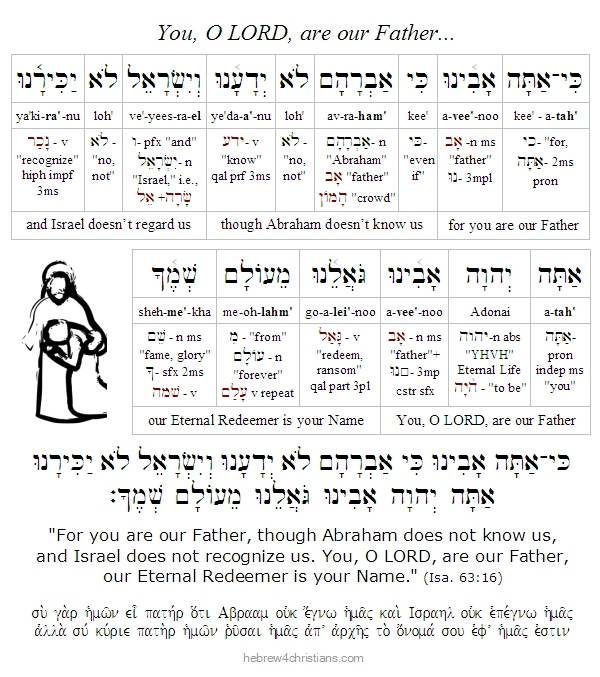
Isa. 63:16 Hebrew page (pdf)
Thank You for sharing this encouragement, I was fighting inside myself for many days , with many questions ; I‘ m a Child of God but why do I have so many doubts about my identity in Christ, I don’t doubt about God , I believe and trust him but I a fight with myself.
Your message is encouraging me to trust in his grace «and you must let your spirits and minds keep being renewed,»
Ephesians (Eph) 4:23 CJB
https://bible.com/bible/1275/eph.4.23.CJB
THANKYOUFORYOURHOLY
ILLUMANATION🙏